14.10.2026
Matthias Guckenberger appointed Honorary Fellow of the American College of Radiology
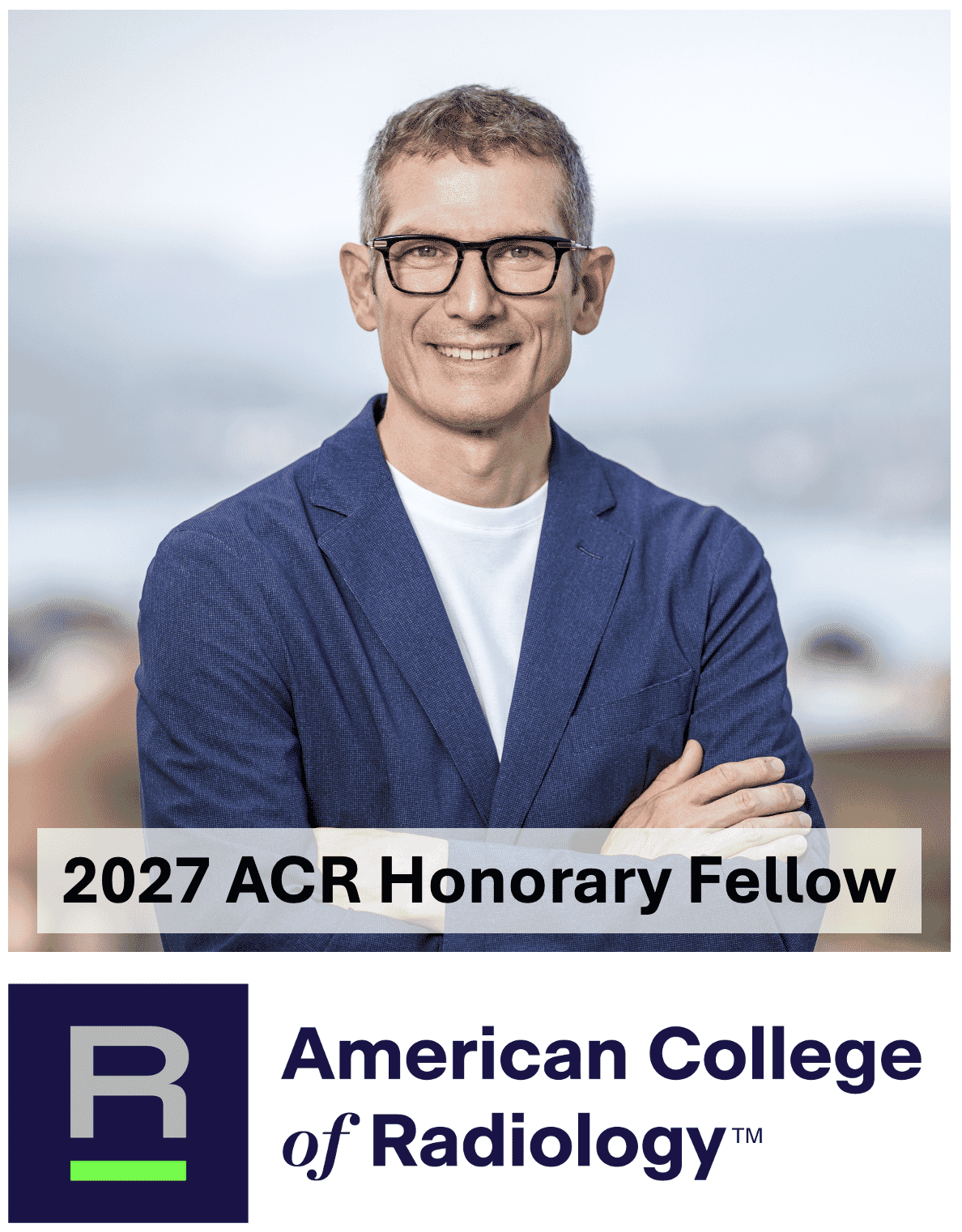
A special honor for Prof. Dr. med. Matthias Guckenberger, Director of the Department of Radiation Oncology at University Hospital Zurich (USZ): the American College of Radiology (ACR) will appoint him an Honorary Fellow in 2027. He is the first Swiss radiation oncologist to receive this distinction.

Photo: ACR media release
The ACR Honorary Fellowship is among the most prestigious international honors in radiology. It is awarded only to outstanding individuals who advance the field of radiology and are especially committed to science, education and medical care.
The American College of Radiology has more than 40,000 members, making it one of the world’s leading professional societies for radiology, radiation oncology and medical imaging, with a major influence on the field internationally.
Matthias Guckenberger is regarded as an international pioneer of stereotactic precision radiotherapy (SBRT), particularly for lung cancer and oligometastases. He served as President of the European Society for Radiotherapy and Oncology (ESTRO) and has worked for years to bring imaging and radiation therapy closer together in both clinical care and research.
Our warmest congratulations. We are delighted that his expertise makes University Hospital Zurich and the Zurich research location visible far beyond national borders.
Im Gespräch mit Matthias Guckenberger
Matthias Guckenberger, you will be appointed an Honorary Fellow of the American College of Radiology in 2027 – the first Swiss radiation oncologist to receive this honor. What does this distinction mean to you?
It is an extraordinary honor that fills me with great gratitude. The fact that this recognition comes from a leading international society and from the neighboring discipline of radiology makes it especially valuable. Modern oncology thrives on seamless collaboration across the boundaries of disciplines, institutions and countries. I try to build such bridges in clinical patient care and in research, in particular between imaging and precision radiotherapy. I therefore see this recognition as confirmation of a scientific path that is consistently built on cooperation.
You are considered an international pioneer of stereotactic precision radiotherapy (SBRT). Looking back, which advance in lung cancer and oligometastases was the decisive one?
The paradigm shift in metastatic disease. In the past, metastatic disease was almost always considered purely palliative. Today we can destroy tumor sites in all regions of the body with millimeter precision while maximally sparing healthy tissue. The enormous technological progress in radiation oncology becomes clinically relevant especially when modern, sensitive diagnostics detect a cancer at a stage that is not yet too advanced and effective new drug therapies are available at the same time. Optimally bringing together and combining these different aspects of precision oncology will continue to challenge us in the future.
“This award belongs in equal parts to my team at University Hospital Zurich and the University of Zurich, and to all our companions worldwide.”
Matthias Guckenberger
Your guiding principle as ESTRO President and USZ department head is “Advancing Cancer Care by Innovation and Partnership”. How is that reflected here?
No breakthrough happens in isolation. Real progress requires the close interplay of clinical care and research, diagnostics and therapy, biology and physics, as well as strong alliances between professional societies such as ESTRO, ASTRO and ACR, our partner institutions and industry. This award belongs in equal parts to my team at University Hospital Zurich and the University of Zurich, and to all our companions worldwide. When we overcome silos, we improve care sustainably.