5.10.2026
Understanding breast cancer cell by cell
For Breast Cancer Awareness Month in October: Researchers at the University of Zurich led by Bernd Bodenmiller have mapped breast tumors cell by cell. The result is a new classification that could help guide therapy choices. A look back at the research and what is still needed before it reaches the clinic.
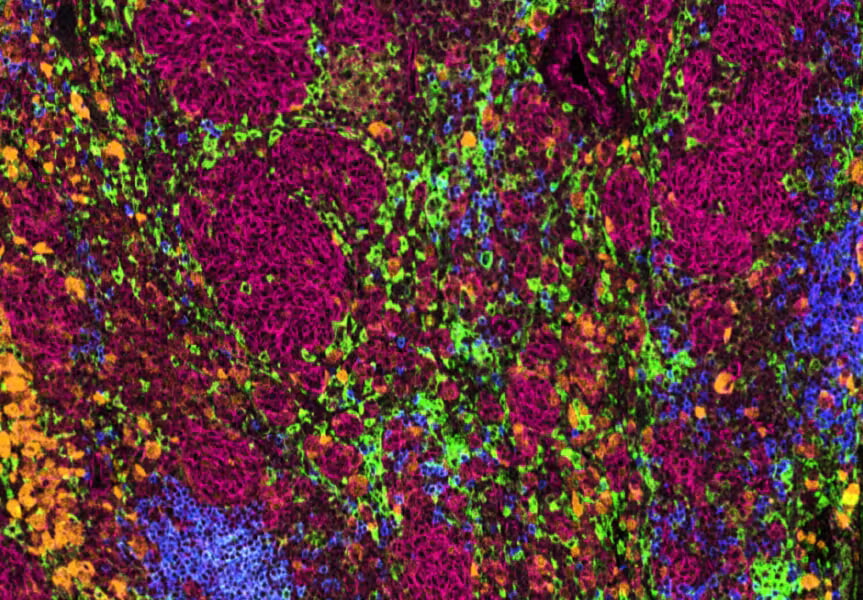
Tumor cells embedded in tissue are stained magenta (Photo: Bodenmiller Lab, University of Zurich).
To assess how dangerous a breast tumor is, pathologists have for decades examined just a few characteristics of the cancer cells – for example, whether the cells respond to female hormones. This approach is well established, but it reveals only a small part of what is happening inside the tumor. How much more can be seen was shown in 2020 by Bodenmiller’s group in the journal Nature. Using a technique developed in their own lab, the researchers made 35 different proteins visible simultaneously in ultra-thin tissue sections – and in every single cell. They studied tumor samples from 352 patients in Basel and Zurich. The result was a kind of map showing which cancer and immune cells occur in the tumor and where they are located. Many later studies build on this map.
The neighborhood is decisive
The map itself already brought new insights to light. The researchers discovered previously unknown groups of breast cancer in which the disease followed different courses. What mattered, then, was not only which cells were present in the tumor, but also how they were arranged – much like in a city, where a great deal depends on who lives next door. The study is considered a milestone in the field. It has been cited around 800 times in other scientific publications, and its data are freely available to researchers worldwide.
Identifying dangerous cells
In 2025, the team applied the approach to so-called triple-negative breast cancer in the journal Cancer Cell. This particularly aggressive form can be treated neither with hormones nor with the common targeted drugs, and it often returns quickly. In the tumors of 215 patients, the researchers found eleven types of cancer cells, with one type predominating in each tumor. One of them stood out: these cells resemble stem cells and combine properties of different cell types of the mammary gland. Wherever they predominated, the cancer returned more quickly. The outlook was more favorable, by contrast, where certain immune cells – so-called killer T cells – were able to reach the cancer cells directly.
Five groups, different outlooks
From these observations, the researchers derived five groups of breast cancer with different chances of recovery. They validated the classification using data from a total of 3,737 patients, across all forms of breast cancer. Tumors infiltrated by many immune cells had good outcomes and often responded to immunotherapy, which strengthens the body’s own immune defenses against the cancer. Tumors with many stem-cell-like cancer cells, on the other hand, followed a less favorable course. The new work shows how basic research can give rise to a tool that could one day help physicians choose the right treatment for each patient.
The road to the clinic
Several further steps are needed before the new classification can be used in hospitals. So far, the results are based on tissue samples and medical records from the past. Whether the five groups actually lead to better treatments must now be shown by studies that follow patients over longer periods. First steps have been taken: in the Zurich Precision Oncology Program, researchers are testing whether the new technique can support clinicians in choosing treatment. In the European research consortium IMMUcan, Bodenmiller’s lab is working with partners to find clues as to which patients respond to immunotherapy. In the long run, looking at the arrangement of cells could become routine alongside the established characteristics. For that to happen, however, the labor-intensive technique must become faster, cheaper and more standardized.