8.06.2026

Research at CCCZ: Understanding Blood Cancers, Developing Immunotherapies, Optimizing Treatments

Recent publications from the Department of Medical Oncology and Hematology (MOH) at the Comprehensive Cancer Center Zurich (CCCZ) highlight the breadth of cancer research in Zurich—from fundamental insights into the origins of blood disorders to new immunotherapies and the optimization of existing treatments.
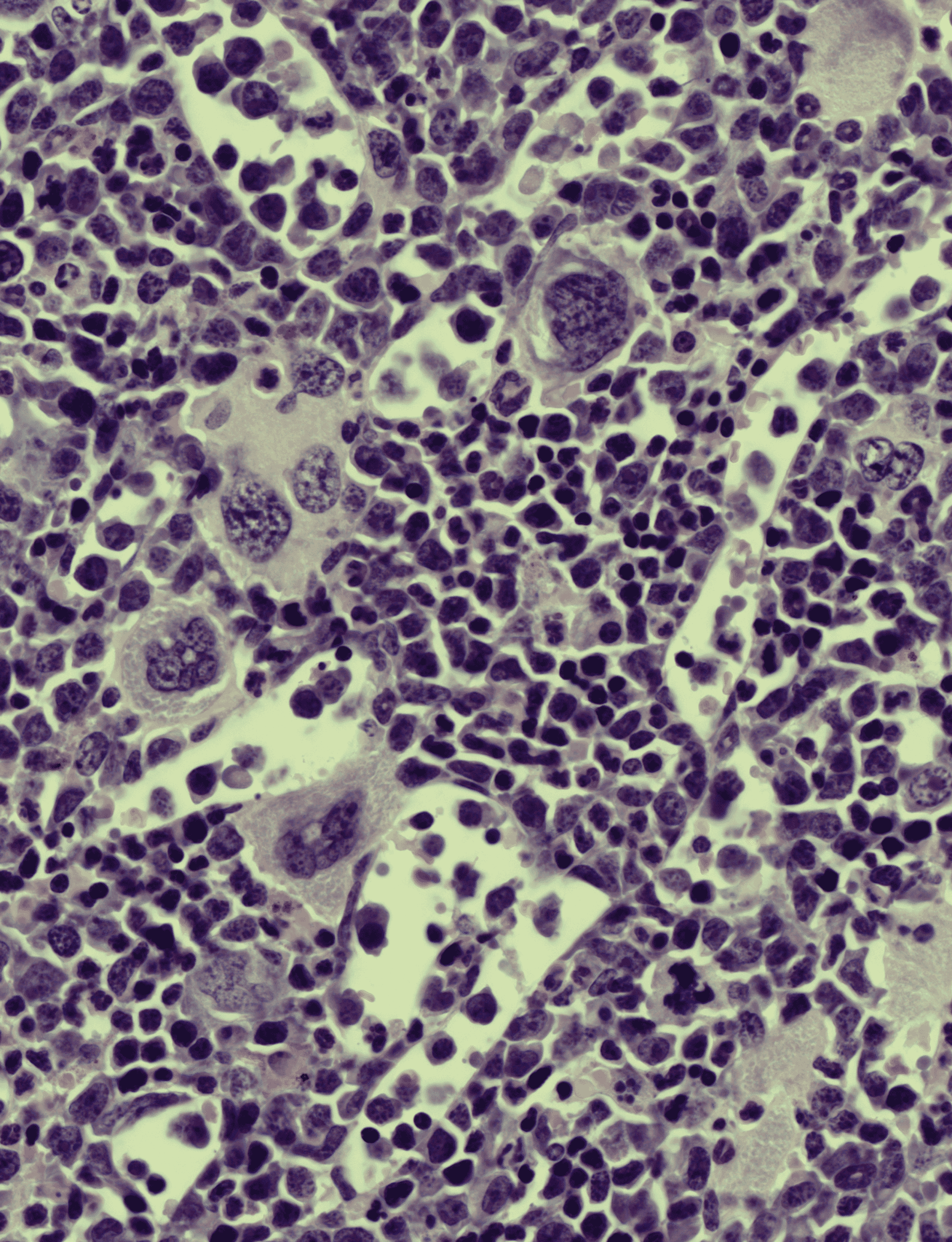
Bloodjournal 147 15.coverfig

Hematoxylin and eosin–stained bone marrow from a mouse transplanted with hematopoietic stem and progenitor cells deficient in Ercc6l2 and Trp53. The image from the publication by R. Schimmer et al. is featured on the cover of Blood, Volume 147, Issue 15.

Cancer medicine emerges from the interplay of basic research, clinical research, and patient care. Researchers and physicians in MOH at CCCZ address questions along this entire continuum—from the biological causes of disease to new therapeutic approaches and the improvement of existing treatments.

Several recent MOH publications exemplify this breadth. They range from fundamental insights into the development of blood cancers to novel forms of immunotherapy and the optimization of treatments following stem cell transplantation..

Understanding Mechanisms of Disease

To treat cancer more precisely, researchers must first understand the biological processes that drive disease. This knowledge is particularly critical in rare blood disorders, where molecular analyses often reveal why certain patients are especially prone to developing leukemia.

When a genetic rescue becomes a risk later on

Schimmer et al., Blood, 2026

Individuals with alterations in the ERCC6L2 gene can develop a rare form of bone marrow failure, in which the marrow no longer produces sufficient blood cells. At the same time, affected individuals have an increased risk of developing myeloid leukemia later in life.

Notably, these patients frequently acquire additional alterations in the TP53 gene. TP53 is a key tumor suppressor gene that normally helps stop or eliminate cells with severe damage.

The study explains why TP53 alterations are so common in this condition. When ERCC6L2 is deficient, hematopoietic stem and progenitor cells experience stress. They accumulate DNA damage, show impaired growth, and are less able to fulfill their function in the bone marrow. If TP53 is also inactivated, these cells can temporarily regain their growth capacity—acting as a form of genetic “rescue” of blood formation.

However, this rescue comes at a cost: DNA damage persists. Without the protective function of TP53, genetically unstable cells can continue to proliferate, increasing the long-term risk of leukemic transformation.

This work illustrates how a short-term beneficial genetic change can contribute to cancer development over time. It provides a striking example of how closely bone marrow failure, genetic adaptation, and leukemia risk are linked.

The study was prominently featured in Blood as a Plenary Paper, accompanied by a commentary, cover placement, and a podcast explaining the findings.


Publication: Blood (2026) 147 (15)

Podcast featuring Steffen Böttcher: Blood Podcast by American Society of Hematology

New Paths in Immunotherapy

Immunotherapies harness the body’s immune system to recognize and eliminate cancer cells. Researchers at CCCZ and its partner institutions are working to expand these approaches to additional hematologic and oncologic diseases and to make them more controllable and adaptable.

CAR T-cells for advanced systemic mastocytosis

Kaiser et al., Leukemia, 2026

Systemic mastocytosis is a rare disease characterized by the accumulation of abnormal mast cells in various organs. Advanced forms can be severe and remain difficult to treat despite new targeted therapies.

The research team investigated a novel immunotherapeutic approach: CAR T cells targeting the surface molecule CD117 (KIT), which is highly expressed on mast cells and plays a central role in this disease.

In preclinical models, CD117 CAR T cells effectively targeted multiple mast cell–based disease models, including mast cell lines, patient-derived mast cells, and malignant bone marrow cells from patients with systemic mastocytosis. In mouse models, repeated CAR T-cell administration inhibited mast cell expansion.

The study suggests that CAR T-cell therapies could be further developed for advanced systemic mastocytosis, offering new perspectives for patients who do not respond adequately to current treatments.


Publication: Leukemia (2026)

A flexible T-cell system against leukemia cells

Volta et al., Molecular Cancer Therapeutics, 2026

Many modern immunotherapies target a single antigen on cancer cells. While effective, this approach has limitations: tumor cells can change, lose target antigens, or express multiple markers simultaneously. This is particularly challenging in acute myeloid leukemia, where many targets are also present on healthy hematopoietic cells.

To address this, researchers developed a modular system consisting of a T-cell engager that activates T cells and interchangeable adapter molecules that bind to different target structures on leukemia cells. Targets studied included CD33 and CD117.

The key advantage is flexibility: T-cell activation is not fixed to a single tumor antigen but can be redirected via adapters to different targets.

In preclinical models, the system effectively eliminated leukemia cells and showed in vivo inhibition of leukemia growth comparable to related adaptor CAR T-cell approaches.

This work points to a potential next generation of immunotherapies—more flexible, controllable, and adaptable to tumor heterogeneity. Such platforms may ultimately enable safer and more personalized treatments.


Publication: Mol Cancer Ther 2026

A similar concept was previously demonstrated in adaptor CAR T-cell approaches: Leukemia (2024)

T-cell engagers with an additional activation signal in AML

Hofstetter et al., Cancer Research Communications, 2026

T-cell engagers are engineered antibodies that bring T cells into direct contact with cancer cells by binding both a tumor antigen and CD3 on T cells, thereby triggering T-cell activation.

A limitation of conventional T-cell engagers is the lack of a second, costimulatory signal, which is important for a strong and sustained T-cell response. In contrast, modern CAR T cells incorporate such signals, for example via CD28 or 4-1BB.

The researchers addressed this in acute myeloid leukemia by combining a CD117×CD3 T-cell engager with a second bispecific antibody targeting CD33 and delivering a CD28-mediated costimulatory signal.

This creates a two-step activation mechanism: CD117 serves as the primary target, CD33 as the secondary signal. Strong T-cell activation occurs when both signals are present.

In preclinical studies, this approach led to enhanced T-cell activation, proliferation, cytokine release, and improved killing of AML cells. Dual targeting also improved specificity by preferentially eliminating cells expressing both CD117 and CD33.

The study demonstrates how T-cell engagers can be rationally enhanced to improve efficacy while increasing targeting precision.


Publication: Cancer Research Communications (2026) 6 (4)

Optimizing Therapies

Not all advances in cancer medicine come from entirely new treatments. Equally important are improvements in combining existing therapies, reducing side effects, and evaluating their benefits in real-world clinical settings.

Combination therapy for chronic graft-versus-host disease

Koch et al., Frontiers in Immunology, 2026

Chronic graft-versus-host disease (cGVHD) can occur after allogeneic stem cell transplantation, when donor immune cells attack the patient’s healthy tissues. The condition can affect multiple organs and significantly impair quality of life.

This study analyzed patients with steroid-refractory or steroid-dependent cGVHD, comparing extracorporeal photopheresis alone with a combination of photopheresis and the JAK inhibitor ruxolitinib.

The combination showed higher and faster response rates in this retrospective analysis. Importantly, it also had a steroid-sparing effect: after 12 months, significantly more patients in the combination group were able to discontinue corticosteroids completely.

Given the substantial long-term side effects of corticosteroids, treatments that act faster and reduce steroid exposure can make a meaningful difference for patients. This study provides valuable real-world evidence on effective combination strategies.


Publication: Front. Immunol., 22 April 2026

These studies illustrate how research at CCCZ integrates multiple levels of cancer medicine: precise understanding of biological mechanisms, development of new immunotherapies, and optimization of existing treatments. Together, these efforts generate insights that not only explain disease and treatment responses but also open new avenues for more targeted, effective, and patient-centered cancer care.

Donations and research support

Would you like to support research at CCCZ as a patient, patron or company?