24.08.2026

Research at the Tumor Profiler Center

Comprehensively Profiling Tumors, Understanding Resistance, and Advancing AI-Based Diagnostics
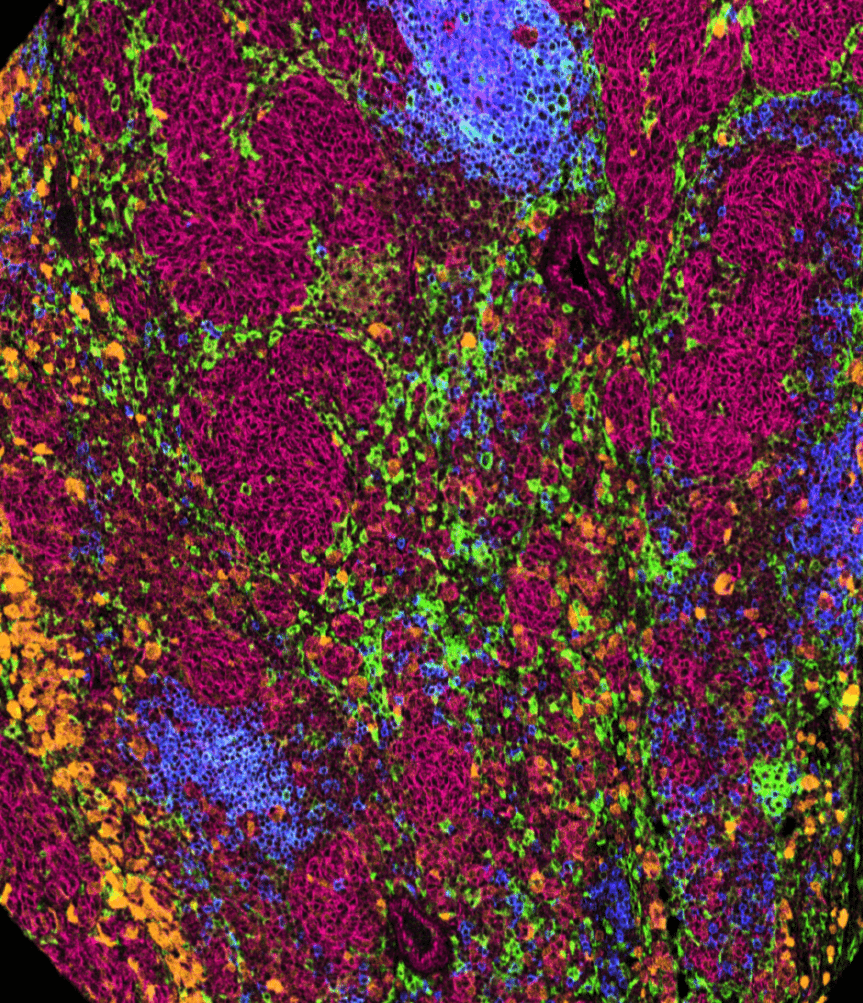
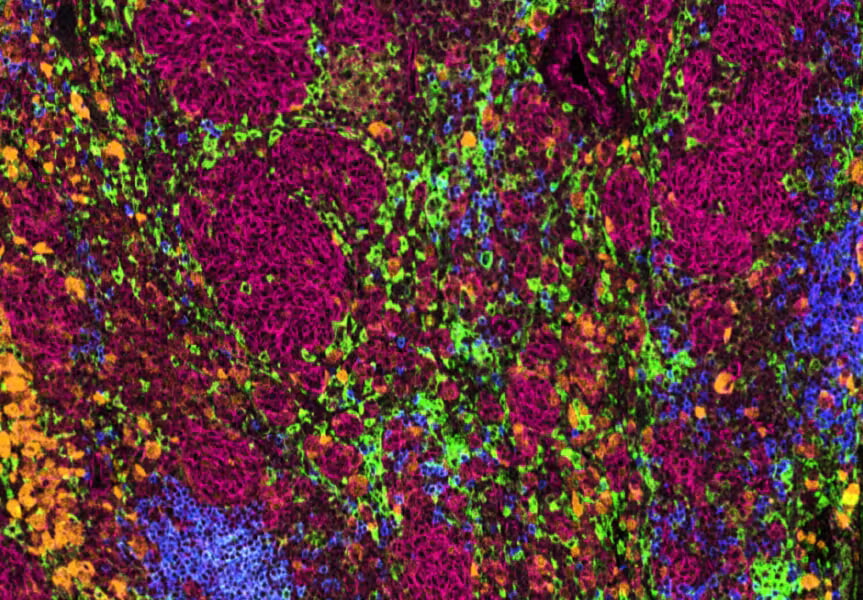
Example IMC Image

Fluorescence image of tumor tissue

Precision oncology depends on understanding tumors ever more precisely – at the genetic, molecular, and cellular level – and translating this knowledge into practice quickly enough to actually inform treatment decisions. Together, the CCCZ and the Tumor Profiler Center (TPC) form a dynamic hub in Zurich that drives cancer research and medicine, technology development, data science, and the training of young talent in precision oncology – for the benefit of cancer patients.

The TPC is a research consortium that brings together the University of Zurich, the University Hospital Zurich, ETH Zurich, and the University Hospital Basel. At its core are state-of-the-art, integrated multi-omics methods for tumor profiling, along with advanced artificial intelligence algorithms that support clinical decisions in precision oncology and enable individualized treatment plans for cancer patients.

Several recent publications involving the TPC illustrate this breadth. They range from the question of how comprehensive tumor profiling can change treatment decisions in ovarian cancer, to new insights into resistance to targeted therapies in lung cancer, to an artificial intelligence system that can read complex tissue images and put them to use for diagnostics.

Comprehensive Tumor Profiling in Practice

For treatments to be truly tailored to the individual tumor, a single genetic test is often not enough. Only the interplay of different levels of analysis reveals how differently tumors can behave – even within the same type of cancer

A Look at Tumor Diversity Changes the Choice of Therapy

Jacob et al., Nature Communications, 2026

High-grade serous ovarian carcinoma, the most common form of ovarian cancer, is considered particularly difficult to treat. Chemotherapy remains the standard treatment, even though it has long been known how differently these tumors behave from patient to patient – and even within one and the same tumor in the same patient.

As part of the TPC, the research team investigated whether comprehensive, multilayered tumor analysis could improve treatment decisions within a clinically meaningful time frame. In 62 patients from Zurich, Basel, and Liestal, blood, tumor tissue, and ascites fluid were analyzed using up to eleven different technologies – ranging from genomic analysis and protein measurements to functional tests in which tumor cells were directly exposed to drugs. The complete analysis was available within four weeks in each case.

The result: an interdisciplinary tumor board changed the hypothetical treatment recommendation for a large proportion of patients when the additional analyses were taken into account. In one subgroup, maintenance therapy adjusted in this way after chemotherapy – for example, the choice of a specific PARP inhibitor or the addition of other agents – was associated with longer survival, although this observation must be interpreted cautiously given the lack of randomization. The study also showed that chemotherapy itself changes the composition of tumor cells: actively dividing cells decrease, while the remaining cells become more diverse. Tumors with a complete doubling of their genome stood out in particular – they tended to recur earlier and responded differently to drugs in laboratory tests.

The study shows that comprehensive tumor profiling can be carried out within clinically usable time frames and can provide valuable additional information for treatment. The findings are already feeding into a follow-up interventional study, the “OV Precision Trial.”

Link to publication: Nature Communications (2026)

Understanding Resistance to Targeted Therapies

Targeted drugs often work very well at first – but in many patients, they lose their effectiveness over time. To detect resistance early, researchers need to understand which additional genetic alterations influence treatment success.

When a Targeted Therapy Reaches Its Limits

Boos et al., npj Precision Oncology, 2026

In advanced, EGFR-positive non-small cell lung cancer (NSCLC), EGFR inhibitors are part of standard treatment. However, how long these drugs remain effective varies greatly from patient to patient, and the reasons for this are not always clear.

The research team examined two large real-world datasets: a cohort from the University Hospital Zurich comprising 43 patients, and an international database with almost 2,000 affected individuals. The central question was whether additional genetic alterations already present alongside the EGFR mutation at the time of diagnosis influence how long an EGFR-directed therapy remains effective.

The results showed that additional alterations in the ERBB2, PIK3CA, and TP53 genes were associated with a significantly shorter duration of treatment effect – a pattern that held true for both newer and older EGFR inhibitors and in both patient groups studied. TP53 alterations were the most common, and certain gene segments particularly important for the gene’s function were linked to a short duration of effect.

These findings support performing a more comprehensive genetic workup already at the time of diagnosis. This could help identify early on which patients may respond to standard therapy for a shorter time – and who might benefit from closer monitoring or an adjusted treatment strategy.

Link to publication: npj Precision Oncology (2026)

Artificial Intelligence for Tumor Diagnostics

Modern tissue analyses today produce images in which thousands of individual cells and many different proteins are made visible simultaneously. Evaluating these vast amounts of data by hand is barely feasible anymore – this is where artificial intelligence comes in.

When Artificial Intelligence Learns to Read Tissue

Wenckstern et al., Nature, 2026

So-called spatial proteomics methods show where in the tissue which cells are located and which proteins they carry – important information about, for example, how tumor and immune cells interact with one another. One problem: each study typically uses its own selection of markers and its own measurement technique, which has so far made it difficult to compare data across different studies.

The research team therefore developed “Virtual Tissues” (VirTues), an AI foundation model trained on tissue images from more than 3,000 patients and over one hundred different protein markers. Unlike previous approaches, VirTues can flexibly handle different marker combinations and measurement techniques. The model can identify and classify individual cells, detect functional neighborhoods within tissue, and even estimate values for markers that were not directly measured in a given study.

The benefit was especially striking in triple-negative breast cancer: patterns derived from VirTues predicted which patients would respond to a combination of chemotherapy and immunotherapy, and in an independent patient group they reliably distinguished between higher and lower risk of relapse – with markedly greater accuracy than previously established biomarkers and standard clinical classifications.

This work shows how artificial intelligence can help harness the growing complexity of modern tissue analyses. Such a tool could help bring together data from many different studies and technologies and identify new biomarkers for personalized cancer treatment. The long-term goal is also for model-based predictions to be tested in clinical trials in the future.

Link to publication: Nature (2026)

These studies show how research involving the TPC connects different levels of precision oncology: the practical application of comprehensive tumor analyses in the clinic, a precise understanding of why targeted therapies lose their effect over time, and the development of new, AI-powered tools to make meaningful use of the ever-growing volume of data. From this interplay emerge approaches that will help treat patients more precisely, more effectively, and more individually in the future.
Logo Tpc Square V2 Transparent

Tumor Profiler Center

The Tumor Profiler Center (TPC)  is a research consortium spanning the University of Zurich, the University Hospital Zurich, the ETH Zurich, and the University Hospital Basel. The consortium focuses on cutting-edge, integrated, multi-omics tumor profiling techniques and advanced artificial intelligence algorithms to support clinical decision-making in precision oncology, to guide individualized cancer treatment plans.